🦠Outbreaks
🌍 Türkiye•24 Aug 2026
FMD surveillance highlights the importance of rapid outbreak response
Recent developments underline the importance of surveillance, early detection and coordinated disease-control measures.
FMD Intelligence
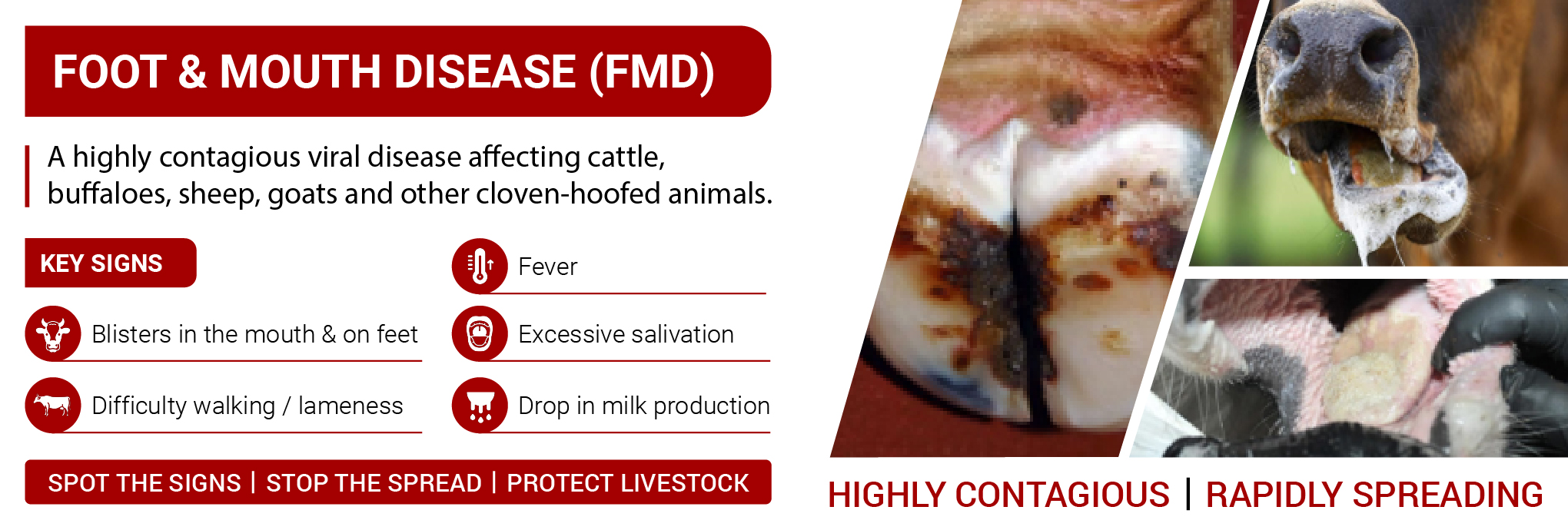
Foot-and-Mouth Disease (FMD) is a highly contagious, single-stranded RNA viral infection caused by an Aphthovirus of the Picornaviridae family that inflicts severe economic and agricultural losses globally by primarily targeting cloven-hoofed domestic and wild animals—such as cattle, pigs, sheep, goats, and deer. The disease spreads rapidly through direct contact with infected bodily secretions, contaminated inanimate objects via indirect contact, and airborne transmission over considerable distances depending on meteorological conditions. Following an incubation period typically ranging from 2 to 14 days, the virus causes widespread outbreaks that remain endemic across vast regions of Africa, the Middle East, and Asia, whereas strict quarantine and biosecurity measures allow regions like North America, Australia, New Zealand, Chile, and much of Europe to maintain official FMD-free status (World Organisation for Animal Health, 2023; Alexandersen et al., 2003).

A highly contagious livestock disease
Disease Overview
Foot-and-Mouth Disease is one of the most contagious viral diseases affecting livestock. Because the virus can spread rapidly, an outbreak can have a significant impact on animal health, farm productivity and livestock trade.
Key Point
Early recognition and rapid disease-control measures are important because FMD can spread quickly among susceptible animals.
Disease Intelligence
Select a question below to explore detailed information about the disease.

Clinical Signs
Signs & Symptoms
Follow the typical progression of Foot-and-Mouth Disease — from initial exposure to rapid transmission.
Key Takeaway
FMD spreads extremely efficiently, primarily through infected animals, contaminated materials, and infectious aerosols. Unlike diseases that depend on a specific insect or animal vector, FMD is mainly transmitted through direct and indirect contact, with environmental conditions and livestock movements strongly influencing how quickly an outbreak expands.
Understand how FMD moves between animals and farms, which transmission routes matter most and how environmental and movement factors can increase risk.
Lumpy Skin Disease Virus (LSDV) is transmitted predominantly by blood-feeding arthropods through mechanical transmission. Flies, mosquitoes and ticks can transfer virus-containing blood between infected and susceptible cattle.
Blood-feeding arthropods are the most important transmission drivers for LSD. Vectors can acquire LSDV-containing blood from infected cattle and mechanically transfer the virus during subsequent feeding.
Environmental conditions can influence vector abundance and activity. Warm and humid conditions may favour vector activity and have been associated with increased LSD incidence in epidemiological studies.
Movement of infected cattle can transport LSDV into previously unaffected farms, markets and regions. Once introduced, local blood-feeding vectors can facilitate further transmission.
Transmission Risk
Foot-and-Mouth Disease (FMD) is highly contagious and can spread rapidly between susceptible livestock through direct contact, airborne transmission, contaminated materials, animal movement and the farm environment. Select a factor to explore it.
Key Intelligence
FMD transmission risk increases when infected animals, susceptible animals, contaminated materials and movement networks interact. Strong farm biosecurity, movement management and early detection are therefore central to reducing spread.
Understand why FMD vaccines can fail and how virus mismatch, waning immunity, cold-chain breaches, administration errors, antigenic variation and host or environmental factors can influence protection.
FMD vaccines stimulate the animal's immune system to recognize relevant viral antigens and develop protective antibodies. Effective protection depends on an appropriate vaccine match, adequate immune response and correct vaccination practices.
FMD control programmes primarily use inactivated vaccines formulated against relevant FMD virus serotypes and strains. Because FMD has multiple serotypes and antigenically diverse viruses, vaccine selection must reflect the circulating field virus.
Protection depends on both the antigenic match between the vaccine and circulating field virus and the strength and duration of the animal's immune response.
Vaccine Performance
FMD vaccine performance can be affected by viral variation, declining immunity, cold-chain breaches, administration errors and host or environmental factors. Understanding these factors helps identify possible reasons for vaccine failure.
Key Factors
Select a factor to explore its details.
Key Intelligence
FMD vaccine failure is usually multifactorial. Effective protection depends on an appropriate vaccine–field virus match, maintenance of protective immunity, strict 2°C–8°C cold-chain conditions, correct dosing and administration, appropriate vaccination timing, and consideration of host and environmental factors.
Explore representative field scenarios that show how vaccine matching, immunity, vaccine handling and viral pressure can influence FMD control.
Explore Case Studies
Part 08 • Global Disease Surveillance
Explore the major Foot-and-Mouth Disease (FMD) events that shaped modern prevention, control, vaccination and eradication strategies.
Surveillance dashboard
Global FMD situation overview
Global Disease Timeline
Key historical and recent FMD events that shaped modern disease surveillance, prevention, vaccination, movement control and outbreak-response strategies.
Explore Timeline
Surveillance Records
8 records shown
Global Intelligence
FMD history demonstrates that animal movement, international trade, wildlife reservoirs, high-density livestock production, gaps in biosecurity and susceptible populations can drive transboundary spread. Sustained surveillance, vaccination, movement management, early detection, rapid response and coordinated international preparedness remain essential components of FMD control.
Track the latest developments in FMD outbreaks, vaccines, policy and scientific research around the world.
Feed Status
Monitoring Active
Outbreak
Recent developments underline the importance of surveillance, early detection and coordinated disease-control measures.
Latest
Recent developments underline the importance of surveillance, early detection and coordinated disease-control measures.
Vaccine selection and antigenic matching continue to be important considerations in regional FMD vaccination programmes.
Cross-border coordination, surveillance and movement controls remain important tools for reducing transboundary disease risks.
Ongoing research focuses on virus evolution, antigenic characteristics and improving disease surveillance.
Veterinary authorities continue strengthening monitoring and reporting systems to identify emerging disease activity.
Improving vaccination coverage and maintaining effective vaccination schedules remain key components of FMD control.
Intelligence Feed
News content should be connected to verified veterinary authorities, international organisations, research institutions and trusted news sources. Dates, countries and outbreak information should be refreshed automatically when a live feed is connected.
Key facts and figures that explain how Foot-and-Mouth Disease spreads, affects animals and creates global livestock risks.
FMD spreads quickly between susceptible livestock and can move rapidly through direct and indirect transmission routes.
The incubation period is typically 2–14 days, depending on the virus strain, exposure dose and host.
FMD virus has seven recognised serotypes: O, A, C, Asia 1, SAT 1, SAT 2 and SAT 3.
FMD affects cattle, pigs, sheep, goats, buffalo and other susceptible cloven-hoofed animals.
In highly susceptible populations, most exposed animals may become infected, with morbidity reaching up to 100%.
Transmission
FMD is highly contagious and can spread rapidly between susceptible livestock through direct contact and contaminated materials. Major routes include livestock movement, animal products, people, vehicles, equipment and other contaminated materials.
Infected Animal
Virus & Secretions
Movement
Equipment & Vehicles
People
Contaminated Materials
Susceptible Host
Economic & Farm Impact
FMD can cause significant reductions in milk and meat production.
Deaths may occur, particularly in young animals affected by severe cardiac damage.
Livestock movement may be restricted during outbreaks to reduce disease transmission.
Disease-control measures, surveillance and outbreak response can substantially increase costs.
FMD outbreaks can have major consequences for international livestock and animal-product trade.
Virus Diversity
FMD virus consists of seven immunologically distinct serotypes. Immunity to one serotype does not necessarily provide protection against another.
One of the most widely reported FMD serotypes.
Important serotype requiring appropriate vaccine matching.
One of the seven recognised FMD serotypes.
Historically important across parts of Asia and surrounding regions.
Southern African Territories serotype.
Southern African Territories serotype.
Southern African Territories serotype.
One of the seven recognised FMD serotypes and widely reported in different regions.
An important FMD serotype requiring appropriate antigenic matching for vaccination.
One of the seven recognised FMD serotypes.
A recognised FMD serotype historically associated with parts of Asia and surrounding regions.
Southern African Territories serotype associated primarily with regions of Africa.
Southern African Territories serotype associated primarily with regions of Africa.
Southern African Territories serotype associated primarily with regions of Africa.
FMD can spread quickly between susceptible livestock, making early detection and rapid control measures essential.
FMD has seven recognised serotypes, and immunity to one serotype does not necessarily protect against another.
FMD affects multiple cloven-hoofed hosts and remains an important livestock disease across parts of Africa, Asia and the Middle East.
FMD can cause production losses, animal deaths, control costs, movement restrictions and trade disruption.
Rapid diagnosis and reporting are critical for effective containment and outbreak response.
Vaccination is a key tool for reducing transmission and protecting susceptible livestock when appropriately matched to circulating virus strains.
Numerical ranges shown here are intended as general disease-intelligence indicators. Exact transmission, incubation, morbidity, mortality and host susceptibility can vary by virus strain, animal species, exposure dose, exposure route and epidemiological conditions.
Explore scientific literature, international surveillance, technical reports and research evidence related to Foot-and-Mouth Disease.
Evidence Base
Peer-reviewed FMD research provides evidence on pathogenesis, diagnosis, virus shedding, transmission, airborne spread and host susceptibility.
WOAH and FAO provide structured information on FMD outbreaks, epidemiology, serotypes, emerging risks and international disease-control activities.
Technical assessments and control strategies translate surveillance findings into practical recommendations for prevention, preparedness and response.
World Organisation for Animal Health (WOAH)
WOAH Disease Information
Provides authoritative information on FMD disease definition, susceptible hosts, serotypes, clinical signs, incubation, mortality, surveillance and official disease-free status.
Disease definition • Hosts • Serotypes • Clinical signs • Incubation • Mortality • Surveillance • Disease-free status
World Organisation for Animal Health (WOAH)
Technical Disease Card, Paris. 2025.
Technical reference covering FMD epidemiology, transmission, clinical signs, diagnosis, prevention and disease-control measures.
Epidemiology • Transmission • Clinical signs • Diagnosis • Prevention • Control
Food and Agriculture Organization of the United Nations (FAO)
FAO Animal Health
Provides information on the global FMD situation, emerging risks, surveillance activities and current FMD events.
Global disease situation • Emerging risks • Surveillance • Current FMD events
FAO/EuFMD — European Commission for the Control of Foot-and-Mouth Disease
Global FMD Situation
Describes the global distribution of FMD, endemic regions, regional epidemiological pools and international approaches to disease control.
Global distribution • Endemic regions • Epidemiological pools • International control
FAO/EuFMD — European Commission for the Control of Foot-and-Mouth Disease
Global FMD Control Strategy
Supports international coordination, regional control programmes and the Progressive Control Pathway for Foot-and-Mouth Disease.
International coordination • Regional control • Progressive Control Pathway • Disease management
Food and Agriculture Organization of the United Nations (FAO)
Rapid Risk Assessment: FMD Virus Serotype SAT1. Published 4 March 2026.
Assesses the recent emergence of FMD virus serotype SAT1, transboundary spread risks, contributing factors and preparedness recommendations.
SAT1 emergence • Transboundary spread • Risk factors • Preparedness • Response
Food and Agriculture Organization of the United Nations (FAO)
Situation Update and Recommendations for Prevention, Preparedness and Response in the Near East and West Eurasia. 2025.
Provides information on SAT1 emergence in the Near East and highlights vaccination, biosecurity and surveillance as important components of preparedness and response.
SAT1 emergence • Vaccination • Biosecurity • Surveillance • Preparedness • Response
Alexandersen, S., Zhang, Z., Donaldson, A. I., & Garland, A. J. M.
Journal of Comparative Pathology, 129(1), 1–36. 2003.
DOI: 10.1016/S0021-9975(03)00041-0
A detailed scientific review covering FMD pathogenesis, diagnosis, virus excretion, immune responses and the carrier state.
Pathogenesis • Diagnosis • Virus excretion • Immune response • Carrier state
Alexandersen, S., et al.
Journal of Comparative Pathology, 129(4), 268–282. 2003.
Experimental research examining quantitative virus excretion and transmission in experimentally infected pigs and cattle, including differences between host species.
Host susceptibility • Virus shedding • Transmission • Pigs • Cattle • Species differences
Gloster, J., et al.
Veterinary Record, 152(17), 525–533. 2003.
DOI: 10.1136/vr.152.17.525
Research examining airborne transmission of FMDV during the 2001 UK epidemic and the influence of meteorological conditions on disease spread.
Airborne transmission • Aerosol spread • Meteorological influences • FMD epidemic
Gloster, J., et al.
Veterinary Record, 156(25), 793–803. 2005.
Provides epidemiological and meteorological evidence relating to airborne transmission during the 2001 UK FMD epidemic.
Epidemiology • Meteorology • Airborne transmission • UK 2001 epidemic
Gloster, J., et al.
Epidemiology & Infection. 2006.
DOI: 10.1017/S0950268805004073
Reassesses the likelihood of long-distance airborne FMD transmission and examines the role of weather conditions in disease spread.
Long-distance airborne spread • Weather conditions • Epidemiology • FMD transmission
Evidence Framework
Different evidence sources answer different questions. Scientific studies help explain FMD biology and transmission mechanisms, while official surveillance and technical reports provide information about disease occurrence, emerging risks and control strategies.
Pathogenesis, diagnosis, virus shedding, transmission and airborne spread
Disease status, outbreaks, hosts, serotypes and official international reporting
Global disease situation, emerging risks, regional epidemiology and control strategies
Risk assessment, preparedness, prevention and practical disease-control recommendations
Reliable FMD intelligence should be based on traceable scientific publications, official surveillance records and authoritative technical assessments.
FMD evidence should be interpreted using the original scientific publication, official WOAH or FAO surveillance record, or technical report. Scientific evidence can support understanding of disease mechanisms and control, but individual study findings should not automatically be interpreted as a guarantee of vaccine, treatment or control effectiveness.