🦠Outbreaks
🌍 Türkiye•24 Aug 2026
lsd surveillance highlights the importance of rapid outbreak response
Recent developments underline the importance of surveillance, early detection and coordinated disease-control measures.
lsd Intelligence
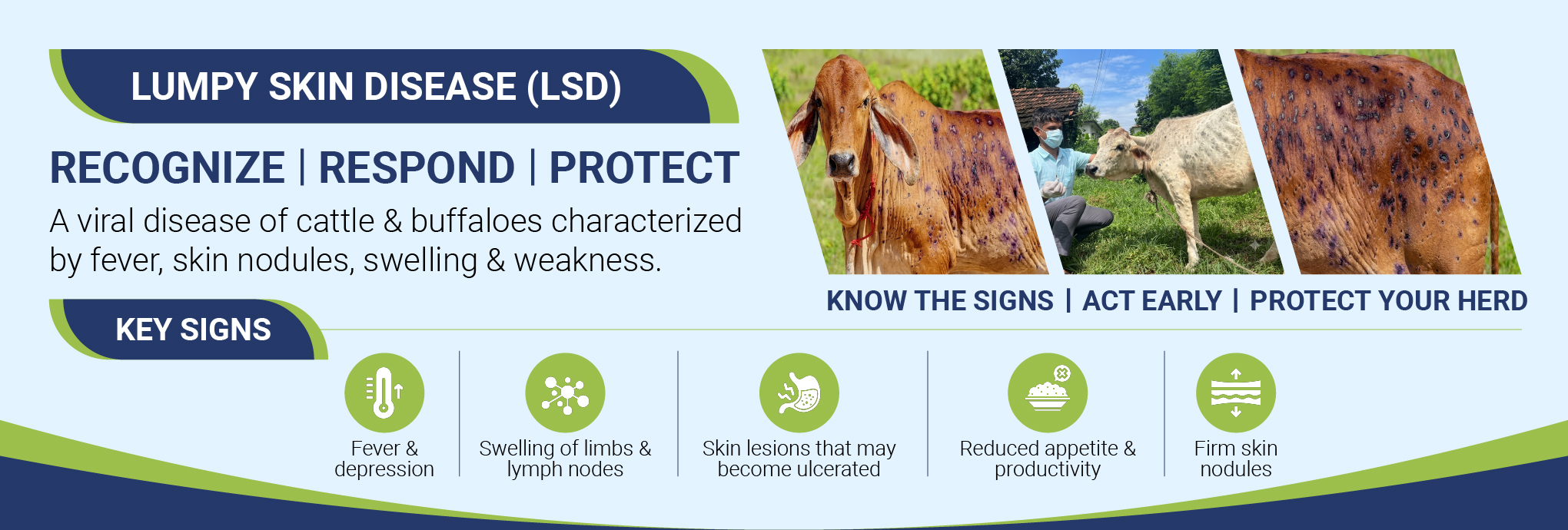
Lumpy Skin Disease (LSD) is an infectious viral disease primarily affecting cattle and water buffalo. It is an important transboundary livestock disease because outbreaks can cause substantial losses through reduced milk production, weight loss, infertility, hide damage, mortality and trade restrictions.
An infectious viral disease primarily affecting cattle and water buffalo
Disease Overview
Lumpy Skin Disease (LSD) is a viral disease of cattle and water buffalo caused by Lumpy Skin Disease Virus (LSDV), a double-stranded DNA virus belonging to the genus Capripoxvirus and family Poxviridae.
Key Point
LSD is primarily a vector-borne disease. Early recognition, vector control, isolation of affected animals and appropriate disease-control measures are important to limit transmission and reduce disease impact.
Disease Intelligence
Select a question below to explore detailed information about the disease.
Clinical Signs
Signs & Symptoms
Follow the typical progression of Lumpy Skin Disease — from initial exposure to the development of clinical signs and recovery.
Key Takeaway
LSD can spread rapidly under favourable conditions, particularly when vector activity is high. Early recognition, isolation of affected animals, vector control, vaccination, movement management and appropriate biosecurity are important components of disease control.
Understand how Lumpy Skin Disease moves between animals and farms, which transmission routes matter most, and how environmental, movement and farm-management factors can increase risk.
LSDV transmission is predominantly associated with blood-feeding arthropods. Infected blood can be mechanically transferred from an infected animal to a susceptible animal through biting vectors.
Vector abundance and activity are important determinants of LSD transmission. Higher vector activity can increase opportunities for virus transfer between cattle.
Environmental conditions can influence vector abundance and activity. Warm and humid conditions may favour vector activity and have been associated with increased LSD incidence in epidemiological studies.
Movement of infected animals can transport LSDV into previously unaffected farms and regions. Once introduced, local vectors can facilitate further transmission.
Transmission Risk
Lumpy Skin Disease is primarily spread by blood-feeding arthropods through mechanical transmission of LSDV-containing blood. Animal movement, vector abundance, environmental conditions, cattle density and gaps in biosecurity can increase transmission opportunities.
Key Intelligence
LSD transmission is predominantly driven by blood-feeding vectors and can be amplified by animal movement, livestock markets, high cattle density, favourable vector conditions and poor vector control or biosecurity. Direct animal-to-animal transmission is generally less important than vector-mediated transmission.
Understand how LSD vaccines stimulate protective immunity, the major vaccine approaches used for disease control, and why vaccinated cattle may still develop clinical disease.
Vaccination introduces viral antigens that stimulate the immune system before exposure to virulent LSDV. Both antibody-mediated and cellular immune responses contribute to protection.
LSD control programmes use different Capripoxvirus vaccine approaches, including live attenuated LSDV vaccines and sheeppox or goatpox-based vaccines. Homologous LSDV vaccines are specifically developed using LSDV vaccine strains.
Vaccination is one of the principal tools for LSD control. Vaccinated cattle can develop stronger protective immune responses and have a lower risk of clinical disease following exposure.
Vaccine Performance
LSD occurring in a vaccinated herd does not automatically mean vaccine failure. Vaccine quality, cold-chain management, administration, vaccination timing, herd coverage, vector pressure, animal health and viral variation should be evaluated.
Key Factors
Select a factor to explore its details.
Key Intelligence
LSD occurring after vaccination does not automatically indicate vaccine failure. Investigation should include laboratory confirmation, vaccination history, vaccine batch and expiry, cold-chain records, reconstitution and administration, vaccination coverage, timing, vector pressure and animal health. Genetic characterization may be considered when indicated.
Explore evidence from vaccine efficacy studies and field investigations showing how vaccination, vector control, environmental conditions, vaccine handling and population immunity influence LSD control.
Explore Case Studies
Part 08 • Global Disease Surveillance
Explore the major Foot-and-Mouth Disease (lsd) events that shaped modern prevention, control, vaccination and eradication strategies.
Surveillance dashboard
Global lsd situation overview
Global Disease Timeline
Key historical and recent lsd events that shaped modern disease surveillance, prevention, vaccination, movement control and outbreak-response strategies.
Explore Timeline
Surveillance Records
8 records shown
Global Intelligence
lsd history demonstrates that animal movement, international trade, wildlife reservoirs, high-density livestock production, gaps in biosecurity and susceptible populations can drive transboundary spread. Sustained surveillance, vaccination, movement management, early detection, rapid response and coordinated international preparedness remain essential components of lsd control.
Track the latest developments in lsd outbreaks, vaccines, policy and scientific research around the world.
Feed Status
Monitoring Active
Outbreak
Recent developments underline the importance of surveillance, early detection and coordinated disease-control measures.
Latest
Recent developments underline the importance of surveillance, early detection and coordinated disease-control measures.
Vaccine selection and antigenic matching continue to be important considerations in regional lsd vaccination programmes.
Cross-border coordination, surveillance and movement controls remain important tools for reducing transboundary disease risks.
Ongoing research focuses on virus evolution, antigenic characteristics and improving disease surveillance.
Veterinary authorities continue strengthening monitoring and reporting systems to identify emerging disease activity.
Improving vaccination coverage and maintaining effective vaccination schedules remain key components of lsd control.
Intelligence Feed
News content should be connected to verified veterinary authorities, international organisations, research institutions and trusted news sources. Dates, countries and outbreak information should be refreshed automatically when a live feed is connected.
Lumpy Skin Disease (LSD) is a viral disease of cattle caused by Lumpy Skin Disease Virus (LSDV), with major impacts on animal health, productivity and livestock livelihoods.
WOAH describes typical LSD morbidity as approximately 10–20%, although rates can vary between outbreaks and populations.
Typical mortality is generally low, around 1–5%, but severe outbreaks can produce substantially different outcomes.
Characteristic skin nodules can develop approximately 7–19 days after infection.
Cattle are the principal clinically affected host of LSD.
LSD is caused by Lumpy Skin Disease Virus, a Capripoxvirus belonging to the Poxviridae family.
TRANSMISSION INTELLIGENCE
LSDV transmission is predominantly associated with blood-feeding arthropods such as biting flies, mosquitoes and ticks. Direct animal-to-animal transmission is generally inefficient compared with vector-mediated spread.
Infected Cattle
LSDV
Blood-Feeding Vectors
Vector Transmission
Susceptible Cattle
ECONOMIC IMPACT
Clinical disease can cause significant reductions in milk production.
Affected animals may experience reduced body condition and weight gain.
LSD can contribute to reproductive problems, including temporary or permanent bull infertility.
Skin lesions can cause permanent damage to hides and reduce their commercial value.
Outbreaks increase expenditure on supportive treatment, veterinary care and management.
Preventive vaccination programmes require additional investment for disease control.
Control of biting insects and other vectors adds to outbreak-management costs.
Disease outbreaks can lead to restrictions on animal movement and livestock trade.
LSD can disrupt livestock value chains and create wider economic consequences.
VIRUS INTELLIGENCE
Lumpy Skin Disease is caused by Lumpy Skin Disease Virus (LSDV), a double-stranded DNA virus belonging to the Capripoxvirus genus of the Poxviridae family.
Lumpy Skin Disease Virus is the causative agent of LSD.
LSDV belongs to the Poxviridae family of large DNA viruses.
LSDV belongs to the Capripoxvirus genus.
The virus contains a double-stranded DNA genome.
LSDV is recognised as having one serotype.
LSDV has a large double-stranded DNA genome characteristic of poxviruses.
LSDV belongs to the Poxviridae family and Capripoxvirus genus.
Sheeppox and goatpox viruses are closely related but are distinct virus species within the same genus.
LSDV is recognised as having one serotype, unlike FMDV which has multiple serotypes.
Blood-feeding arthropods play the major role in LSDV transmission, making vector control an important part of outbreak management.
LSD can reduce milk production, growth and reproductive performance while causing hide damage and additional management costs.
Vaccination helps increase population immunity and should be combined with surveillance, vector control, movement control and biosecurity.
Disease estimates can vary substantially between outbreaks, animal populations and epidemiological settings. The figures presented here are intended as general LSD disease-intelligence indicators and should not be interpreted as fixed outcomes for every outbreak.
Explore scientific literature, international guidance, surveillance evidence and India-specific research related to Lumpy Skin Disease.
Evidence Base
Peer-reviewed LSD research provides evidence on vaccine efficacy, pathogenesis, epidemiology, transmission, risk factors, molecular characterization and disease control.
WOAH and FAO provide authoritative information on LSD epidemiology, vector-associated transmission, surveillance, vaccination, outbreak response and disease control.
Indian research provides evidence on LSD outbreaks, molecular epidemiology, climatic risk factors, vector-associated transmission and vaccine development across affected regions.
Maneekesorn S, Koonyosying P, Muenthaisong A, et al.
Microbial Pathogenesis. 2025;206:107836.
DOI: 10.1016/j.micpath.2025.107836
A systematic review and meta-analysis evaluating the efficacy and performance of LSD vaccines in cattle, including clinical protection and immune responses.
Vaccine efficacy • Clinical protection • Neutralizing antibodies • Vaccine performance
Indian LSDV epidemiological and molecular research group
Research on LSDV isolates from North India
Research investigating the epidemiology, genetic characteristics and population structure of LSDV circulating in North India, including important affected states.
Haryana • Rajasthan • Himachal Pradesh • LSDV genetics • 2022 outbreaks
Indian epidemiological research
Spatial and climatic epidemiology study of LSD in Uttar Pradesh
Examines the spatial and temporal distribution of LSD outbreaks and evaluates climatic factors associated with disease occurrence in Uttar Pradesh.
Seasonality • Temperature • Humidity • Spatial clustering • Outbreak surveillance
Indian veterinary epidemiological research
LSD outbreak investigation in Punjab
Field epidemiological investigation evaluating risk factors, transmission dynamics and estimated basic reproduction number during an LSD outbreak in Punjab.
R₀ • Vector risk • Flies • Ticks • Farm-level epidemiology
Indian molecular epidemiology research
Molecular investigation of LSDV in Odisha
Research characterizing LSDV associated with the Odisha outbreak and evaluating molecular epidemiology and potential risk factors.
2020 Odisha outbreak • Molecular characterization • Risk factors • Indian epidemiology
Bazid AH, Wasfy M, Fawzy M, Nayel M, Abdelmegeid M, et al.
Veterinary Research Communications. 2023;47(2):767–777.
Evaluates the safety, efficacy and potency of an LSD vaccine containing the Neethling strain in cattle during emergency vaccination.
Emergency vaccination • Vaccine safety • Efficacy • Potency • Neethling strain
Tuppurainen E, Dietze K, Wolff J, et al.
Vaccines. 2021;9(10):1136.
DOI: 10.3390/vaccines9101136
Comprehensive review of vaccines used against LSD, vaccination strategies, vaccine characteristics and factors influencing protection.
Vaccines • Vaccination strategies • Vaccine selection • Disease control
Kumar N, Sharma S, Tripathi BN
Virulence. 2025;16(1):2495108.
Comprehensive scientific review of LSDV pathogenicity, virulence mechanisms and factors influencing disease severity.
Pathogenicity • Virulence • Disease severity • LSDV biology
Brenner J, Bellaiche M, Gross E, et al.
Vaccine. 2009;27(10):1500–1503.
Investigates the appearance of skin lesions following LSDV challenge in vaccinated cattle and contributes to understanding vaccine-associated clinical protection.
Vaccinated cattle • Skin lesions • Challenge studies • Clinical protection
Ayelet G, Abate Y, Sisay T, et al.
Antiviral Research. 2013;98(2):261–265.
Reports preliminary vaccine efficacy observations and assesses the impact of LSD outbreaks on dairy cattle production.
Vaccine efficacy • Dairy cattle • Outbreak impact • Production losses
World Organisation for Animal Health (WOAH)
WOAH Disease Information
Authoritative reference covering LSD disease definition, susceptible hosts, clinical signs, transmission, economic impact, zoonotic status and prevention and control.
Disease definition • Hosts • Clinical signs • Transmission • Economic impact • Zoonotic status • Control
World Organisation for Animal Health (WOAH)
WOAH Terrestrial Manual
Technical reference covering laboratory diagnosis, sample collection, virus detection, PCR and epidemiological investigation of LSD.
Laboratory diagnosis • Sample collection • PCR • Virus detection • Epidemiological investigation
Food and Agriculture Organization of the United Nations (FAO)
FAO Animal Health
Provides guidance on LSD epidemiology, vector-associated transmission, surveillance, vaccination, genomic surveillance and outbreak response.
Epidemiology • Vector transmission • Surveillance • Vaccination • Genomic surveillance • Outbreak response
ICAR–NRCE / ICAR–IVRI and Indian veterinary research institutions
India-specific LSD research
Indian research has addressed the emergence of LSD in 2019, major outbreak waves, molecular epidemiology, vector-associated transmission, climatic risk factors and vaccine development.
2019 emergence • 2022 outbreak wave • Molecular epidemiology • Vector transmission • Climate risk • Vaccine development
ICAR–NRCE / ICAR–IVRI
Indian Council of Agricultural Research
India has developed an indigenous homologous live-attenuated vaccine approach against LSD, representing an important development in national disease-control preparedness.
Indigenous vaccine • Homologous vaccine • Live-attenuated vaccine • Indian disease control
Evidence Framework
Different evidence sources answer different questions. Scientific studies help explain LSD biology, epidemiology, transmission and vaccine performance, while official WOAH and FAO resources provide authoritative information on surveillance, disease control and outbreak response.
Vaccine efficacy, pathogenesis, epidemiology, molecular characterization, transmission and risk factors
Disease definition, hosts, clinical signs, transmission, diagnosis, surveillance and official disease-control guidance
Epidemiology, vector-associated transmission, vaccination, surveillance and outbreak response
Indian outbreaks, molecular epidemiology, climatic risk, vector-associated transmission and vaccine development
Reliable LSD intelligence should be based on traceable scientific publications, official WOAH and FAO guidance, Indian research and authoritative technical assessments.
LSD evidence should be interpreted using the original scientific publication, official WOAH or FAO guidance, Indian research publication or authoritative technical report. Individual study findings should not automatically be interpreted as a guarantee of vaccine, treatment or disease-control effectiveness.